春天是英语诗歌中常见的主题,它象征着新生、希望与自然的复苏,许多诗人通过简洁而富有意象的语言,捕捉春天的细腻之美,以下是一些经典的关于春天的英语小诗歌,它们或短小精悍,或意境深远,适合朗读与赏析。
《Spring》by William Blake
Spring is coming, spring is coming,
Birds, build your nests;
Trees, your leaves;
In the woods let warm sunbeams rest.
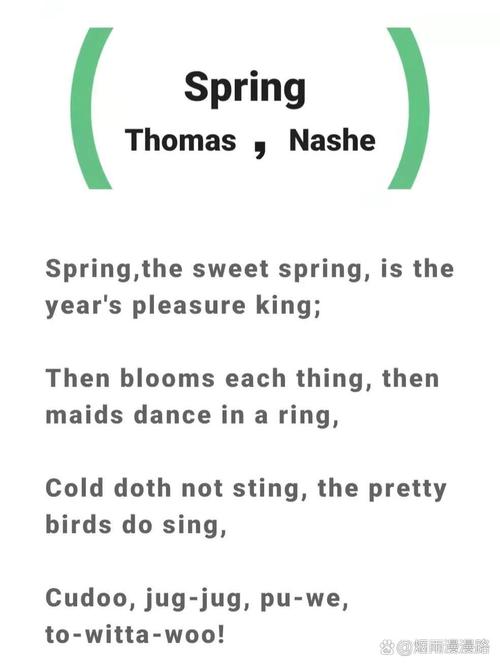
这首诗以重复的句式营造春天的节奏感,鸟筑巢、树抽芽、阳光温暖,寥寥数语勾勒出春天的生机,布莱克的诗歌常带有童真,这首小诗尤其适合儿童朗读,简单却充满画面感。
《A Light Exists in Spring》by Emily Dickinson
A light exists in spring
Not present on the year
At any other period —
When March is scarcely here.
狄金森以独特的视角观察春天,认为春天有一种“光”,这种光并非来自太阳,而是万物复苏时内在的生命力,诗歌短小却深刻,用“光”象征春天短暂而珍贵的存在,引发读者对生命轮回的思考。
《When I Heard the Learn’d Astronomer》by Walt Whitman
When I heard the learn’d astronomer,
When the proofs, the figures, were ranged in columns before me,
When I was shown the charts and diagrams, to add, divide, and measure them,
When I, sitting, heard the astronomer, where he lectured with much applause in the lecture-room,
How soon, unaccountable, I became tired and sick,
Till rising and gliding out, I wander’d off by myself,
In the mystical moist night-air, and from time to time,
Look’d up in perfect silence at the stars.
惠特曼的这首诗虽未直接提及“春天”,但“mystical moist night-air”(神秘湿润的夜气)常与春夜相关,诗歌通过对比科学家的枯燥讲解与个人在自然中的宁静体验,暗喻春天带来的心灵觉醒,强调自然之美超越理性分析。
《Spring and All》by William Carlos Williams
By the road to the contagious hospital
under the surge of the blue
mottled clouds driven from the
northeast—a cold wind. Beyond, the
waste of broad, muddy fields
brown with dried weeds, standing and fallen.
威廉姆斯的诗歌以碎片化的意象描绘早春的荒凉,随后笔锋一转:
“Patient,互助的,
the scanty leaf puts forth its faint purple.”
寥寥数笔,写出生命在严寒中的顽强,春天的希望藏在细微之处,极具现代主义诗歌的张力。
《In Spring》by Christina Rossetti
In spring, I shed my dusty coat
And don my robe of green;
The birds begin to build their nests,
And all the woods are keen.
罗塞蒂的诗歌拟人化自然,将春天比作换上新衣的少女,鸟儿筑巢、树林复苏,充满清新与活力,她的语言简洁押韵,适合作为儿童诗歌或启蒙读物。
以下是关于春天英语诗歌的常见问题解答:
FAQs
-
问:春天主题的英语诗歌有哪些共同特点?
答:春天诗歌常以自然意象(如花朵、鸟鸣、阳光)为核心,语言简洁且富有节奏感,多数诗歌表达对新生与希望的赞美,部分作品(如狄金森)则通过对比突出春天的短暂与珍贵,许多诗人会使用拟人、隐喻等手法,赋予自然以情感或生命力。 -
问:如何选择适合儿童朗诵的春天英语小诗?
答:适合儿童的春天诗歌应具备以下特点:语言简单易懂,句式重复或押韵(如布莱克、罗塞蒂的作品),内容积极向上,充满画面感(如鸟筑巢、树发芽),避免使用复杂意象或抽象哲理,优先选择篇幅短小、朗朗上口的诗歌,Spring》或《In Spring》。