Of course! "Poetry" in English is a vast and beautiful art form. Here's a comprehensive guide covering its definition, types, famous examples, and how to write it.
What is Poetry? (什么是诗歌?)
At its core, poetry is a form of literature that uses aesthetic and rhythmic qualities of language—such as phonaesthetics, sound symbolism, and metre—to evoke meanings in addition to, or in place of, the prosaic ostensible meaning.
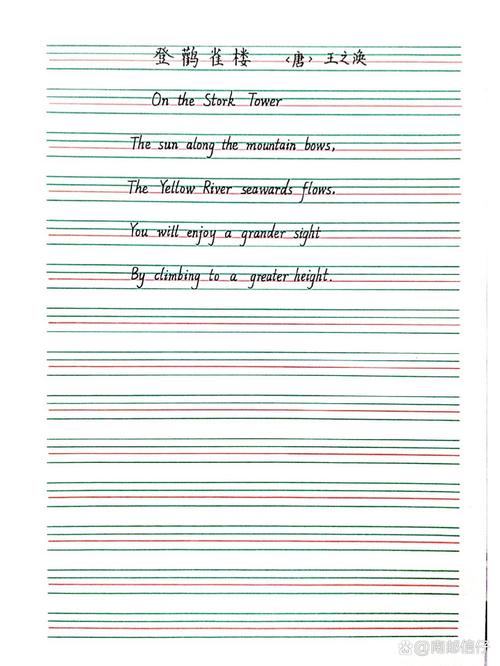
In simpler terms, poetry is:
- Concise: It uses words economically to create maximum impact.
- Emotional: It aims to evoke feelings and images in the reader's mind.
- Musical: It often has a rhythm, rhyme, or sound pattern.
- Imaginative: It uses figurative language like metaphors and similes to create new perspectives.
Key Elements of Poetry (诗歌的关键元素)
To understand poetry, it's helpful to know its building blocks:
- Rhythm (节奏): The beat or flow of the words. It's created by the pattern of stressed and unstressed syllables.
- Rhyme (韵律): The repetition of similar sounds, usually at the end of lines. (e.g., cat / hat, light / night).
- Meter (格律): The rhythmic structure of a verse. A common meter in English is iambic pentameter (five pairs of unstressed-stressed syllables), used by Shakespeare.
- Stanza (诗节): A group of lines in a poem, similar to a paragraph in prose.
- Figurative Language (修辞手法):
- Metaphor (隐喻): A direct comparison between two unlike things (e.g., "All the world's a stage.").
- Simile (明喻): A comparison using "like" or "as" (e.g., "My love is like a red, red rose.").
- Personification (拟人): Giving human qualities to non-human things (e.g., "The wind whispered secrets.").
Famous Types of Poetry (著名诗歌类型)
Here are some of the most common forms of poetry in English:
a) Sonnet (十四行诗)
A 14-line poem with a specific rhyme scheme. The most famous is the Shakespearean Sonnet, which has the rhyme scheme ABAB CDCD EFEF GG.
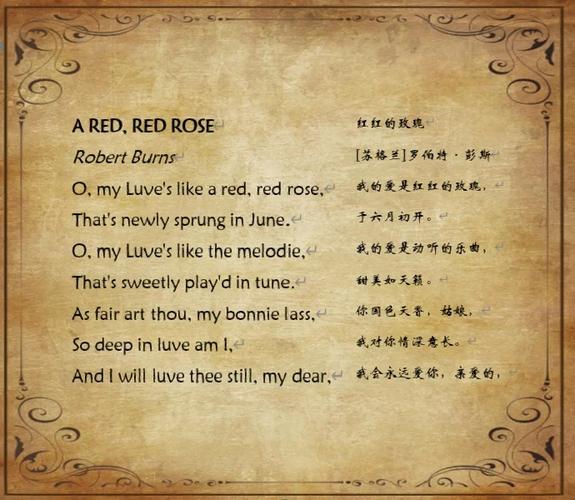
Example: Sonnet 18 by William Shakespeare
Shall I compare thee to a summer's day?
Thou art more lovely and more temperate:
Rough winds do shake the darling buds of May,
And summer's lease hath all too short a date;
...
b) Haiku (俳句)
A Japanese form popular in English, consisting of three lines with a 5-7-5 syllable structure. It often captures a moment in nature.
Example:
An old silent pond...
A frog jumps into the pond—
Splash! Silence again.
c) Limerick (打油诗 / 五行诗)
A humorous, five-line poem with an AABBA rhyme scheme. The first, second, and fifth lines are longer and rhyme, while the third and fourth are shorter and rhyme.
Example:
There once was a man from Nantucket
Who kept all his cash in a bucket.
His daughter, named Nan,
Ran away with a man,
And as for the bucket, Nantucket.
d) Free Verse (自由诗)
Poetry that does not follow a regular rhyme scheme or meter. It relies on natural rhythms of speech and imagery.
Example: "Hope" is the thing with feathers by Emily Dickinson
Hope is the thing with feathers
That perches in the soul,
And sings the tune without the words,
And never stops at all,
e) Narrative Poem (叙事诗)
A poem that tells a story, often with a plot, characters, and a resolution. Epics like The Iliad are long narrative poems.
Example: "The Raven" by Edgar Allan Poe (tells the story of a man haunted by a talking raven).
Famous English Poets and Their Works (著名英语诗人及作品)
| Poet (诗人) | Era (时代) | Famous Work (著名作品) | Brief Description (简介) |
|---|---|---|---|
| William Shakespeare | Renaissance | Sonnets, Macbeth (in verse) | Master of the sonnet and dramatic verse. |
| William Wordsworth | Romantic | I Wandered Lonely as a Cloud | A leader of the Romantic movement, focused on nature and emotion. |
| Robert Frost | 20th Century | The Road Not Taken, Fire and Ice | Known for his accessible style and deep themes about life and choices. |
| Maya Angelou | 20th/21st Century | Still I Rise | An iconic voice of the Civil Rights Movement, powerful and empowering. |
| Langston Hughes | Harlem Renaissance | The Negro Speaks of Rivers, Harlem | A central figure in the Harlem Renaissance, celebrated for jazz poetry. |
| Emily Dickinson | 19th Century | Because I could not stop for Death | A reclusive poet known for her unique use of slant rhyme and dashes. |
How to Write a Simple Poem (如何写一首简单的诗)
You don't need to be Shakespeare to write poetry! Here's a simple guide to writing a short, rhyming poem:
Step 1: Choose a Topic (选择主题) Think of something you care about: nature, a feeling, a person, a memory.
- Example: My cat.
Step 2: Brainstorm Words and Feelings ( brainstorm词语和感受) Write down words related to your topic. Think about how it makes you feel.
- Words: cat, fur, paws, whiskers, purr, soft, quiet, lazy, warm.
- Feelings: calm, happy, cozy.
Step 3: Think of Rhyming Words (想押韵的词) Look for words that rhyme with each other from your list.
- purr / fur, lazy / crazy, quiet / riot
Step 4: Structure Your Poem (构建诗歌结构) Decide on a simple rhyme scheme, like AABB. Try to make the rhythm flow naturally.
Step 5: Write Your Poem (写下你的诗) Put it all together!
Example Poem:
My little cat, with fur so soft and warm, (A) Sleeps through the day, a quiet, lazy storm. (A) Her paws are pads, a silent, gentle sound, (B) As she purrs her comfort all around. (B)
A Famous Poem for You (一首著名的诗送给你)
Here is one of the most beloved poems in the English language.
If— by Rudyard Kipling
If you can keep your head when all about you
Are losing theirs and blaming it on you;
If you can trust yourself when all men doubt you,
But make allowance for their doubting too;If you can wait and not be tired by waiting,
Or, being lied about, don't deal in lies,
Or, being hated, don't give way to hating,
And yet don't look too good, nor talk too wise;... (the full poem is longer and continues with more "if" clauses)
Yours is the Earth and everything that's in it,
And—which is more—you'll be a Man, my son!
I hope this gives you a wonderful introduction to the world of English poetry! Feel free to ask if you want to explore a specific poet, poem, or type in more detail.